The problem
A student in a regional-language school sits in an online lecture delivered in fast English, dense with terms that have no everyday translation — eigenvalue, determinant, characteristic equation. Captions help. Captions in their own language help more. Captions that also explain the jargon are the difference between following the lecture and losing the thread.
Cloud captioning can do this. It also requires bandwidth the student may not have, and it means every lecture they attend leaves their machine. Sahaay does it locally instead: three models, one laptop, no network.
Try it without installing anything
The browser build downloads Whisper once and runs it on your machine, in the tab. Your audio never leaves it.
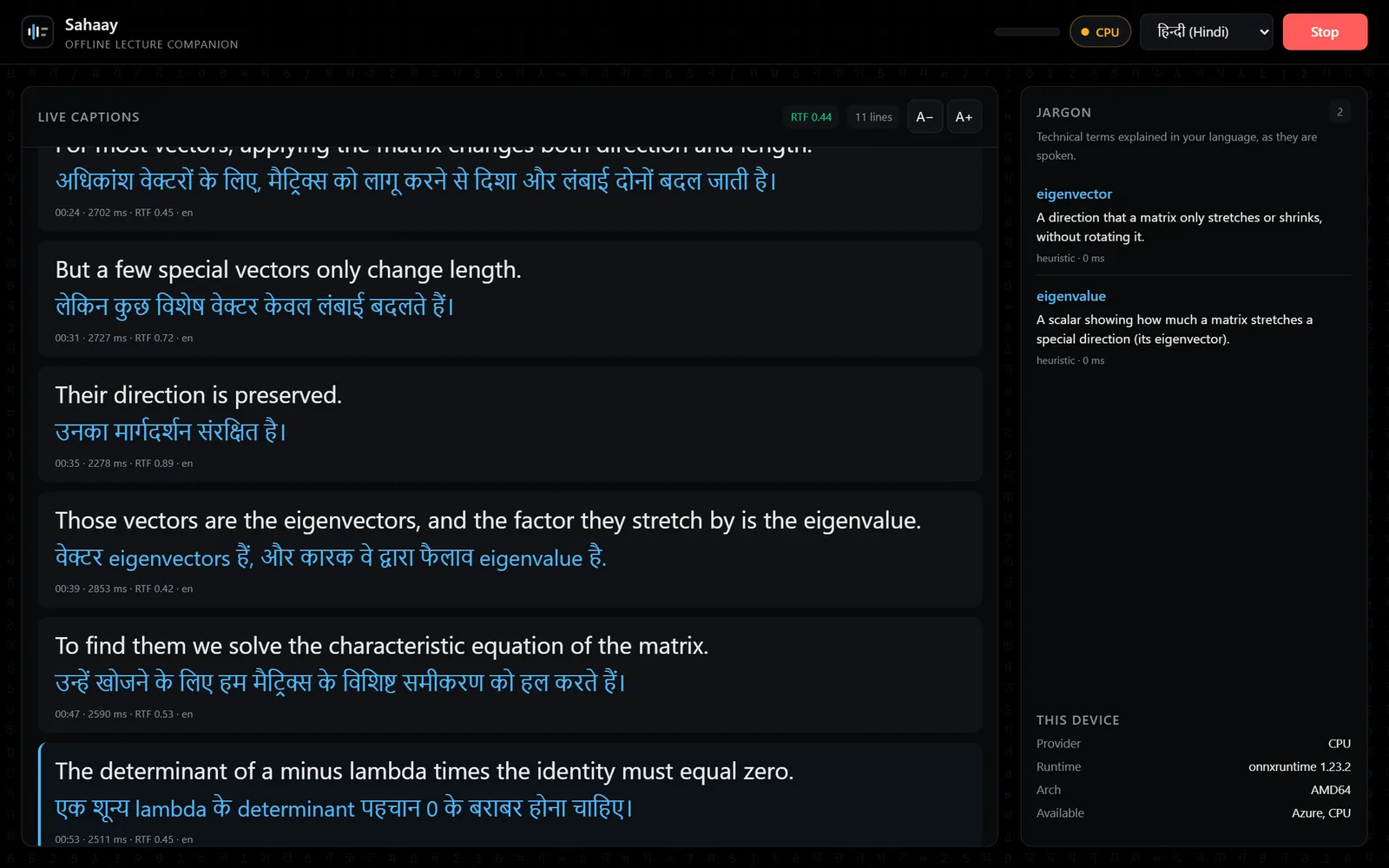
That is not a compromise on the argument — it is the argument, on hardware you already have. The page is static files; the inference happens on your own GPU via WebGPU, or your own CPU via WebAssembly, and the badge in the header names which. Speak into your microphone, or share a browser tab playing a lecture and it will caption that instead.
Pick a language and the captions are translated as well — into any of 22 Indian languages: Hindi, Tamil, Telugu, Kannada, Malayalam, Bengali, Marathi, Gujarati, Punjabi, Odia, Urdu, Assamese, Maithili, Nepali, Kashmiri, Sindhi, Manipuri, Bhojpuri, Awadhi, Chhattisgarhi, Magahi and Mizo. It is the model the desktop app ships, NLLB-200, running in a worker on your machine, with technical terms protected so "eigenvalue" stays eigenvalue. It is about 900 MB, so it downloads only when you pick a language, and once.
Jargon is explained by the same seeded vocabulary the desktop app falls back to when no language model is installed — exported from the same source file, so the two cannot drift.
Watch the RTF badge while it runs. It should hold around 0.5: on the laptop this was tuned on, WebAssembly transcribes the whole test lecture at 0.46–0.50, so the captions keep up. That is one model on the CPU. The measurement below is what happens when a second model, the glossary, runs on the same cores — the part a browser cannot show, and the reason this belongs on a Snapdragon PC.
What the browser build is not. It uses Whisper Base rather than Small, and captures one shared tab rather than all system audio. Translation shares your CPU with Whisper, so each line's translation lands about six seconds after its caption (the captions themselves still keep up), and the 900 MB download is not one for a phone connection. And there is no Hexagon NPU in a browser, so it can show you the problem but not the fix. Those need the desktop build.
Why this needs an NPU
Turn the glossary on, and a CPU stops keeping up with the lecturer.
This is the measurement the project is built around. Sahaay runs Whisper and a language model at the same time, for an hour. On one set of CPU cores they compete directly, and the captions — the thing the user is actually reading — are what lose.
| Whisper latency | Mean | p95 | Real-time factor |
|---|---|---|---|
| Glossary idle | 3275.9 ms | 3422.3 ms | 0.409 |
| Glossary generating | 12400.2 ms | 13241.6 ms | 1.55 |
1.0 is the line that matters. Below it, transcription finishes faster than speech arrives. Above it, every minute of lecture takes more than a minute to caption, so the captions fall further behind and never recover. Moving the Whisper encoder onto the Hexagon NPU removes exactly this contention, and it is why the application belongs on a Snapdragon PC rather than anywhere else.
This number was wrong until 22 Sep 2026. The harness
reported 0.043 → 0.299 and concluded the pipeline still kept up. It had
measured whisper_tiny_en against a synthetic test tone and
recorded neither fact — the model id is auto, so what gets
benchmarked depends on which weights happen to be on the machine. The
product resolves to whisper_small_portable. Both harnesses
now print the model and the signal beside every number.
Measured on Snapdragon silicon
Sahaay was developed without a Snapdragon PC on the desk. Rather than
claim NPU performance that could not be verified, the graphs went to
Qualcomm's own device farm. Every number has its AI Hub job
ID — the job pages open after signing in with a Qualcomm ID, and
the full profiles are in docs/AIHUB.md.
| Device | Inference | Peak memory | Layers on NPU | Job |
|---|---|---|---|---|
| Snapdragon X2 Elite CRD | 13.47 ms | 9.2 MB | 129 / 129 | jglyo70e5 |
| Snapdragon X Elite CRD | 27.56 ms | 17.0 MB | 129 / 129 | j5m0o4zyg |
| Snapdragon X Plus 8-Core CRD | 26.76 ms | 16.8 MB | 129 / 129 | jpxl3m7jp |
129 of 129 layers execute on the NPU — nothing falls back to the CPU. The decoders are deliberately absent from this table; they carry a dynamic KV cache, so a single fixed-shape profile would measure one arbitrary sequence length and read as though it were the cost per caption. It is not.
How it fits together
NPU measured on Snapdragon silicon NPU target built for it, not yet profiled CPU stays on the CPU by design
The detail that matters most
A student can work around a garbled function word. A garbled eigenvalue breaks the link to the textbook — so technical terms are scored separately from everything else, and protected through translation rather than left to chance.
| Set | Utterances | Word error rate | Technical terms kept |
|---|---|---|---|
| English | 4 | 0.0% | 8 / 8 |
| Code-mixed | 3 | 63.6% | 6 / 6 |
| All | 7 | 23.7% | 14 / 14 |
Read this honestly: the audio is synthesised by Windows SAPI, not spoken by people, and only an en-US voice is installed — so the code-mixed row is read with English phonetics. These numbers are a floor, not a forecast. Expect materially worse on a real lecture recording.
Does it survive a whole lecture?
Every other test in the repo runs for seconds. The failure modes of an hour are different in kind: unbounded lists, queues that only grow, event history that accumulates, threads that leak. So the soak test reports slope, not a single number.
Offline is tested, not asserted
"Runs offline" is easy to put on a slide. In this repo it is a test:
tests/test_offline.py patches the socket layer so any
non-loopback connection or DNS lookup raises, then runs a full session
and asserts nothing tried. The guard self-tests first — a guard that
never fires would make the whole test vacuous.
Run it yourself
Windows on ARM64 or x86. The installer picks the right model tier for the machine it lands on.
git clone https://github.com/andringodson/Hackathon-SnapdragonAILab
cd Hackathon-SnapdragonAILab
.\install.ps1
.\run.bat
Then .\run.bat --selftest reports what works, what is
degraded and what failed — and every line that is not OK says what to do
about it. No Snapdragon device? It runs on CPU, more slowly, and the
badge in the header says so rather than pretending.
What is not proven yet
Stated here rather than left for a judge to find:
- The full three-model pipeline has never run on physical Snapdragon hardware. Individual graphs have, on Qualcomm's device farm, at 129/129 layers on the NPU. The end-to-end run on one machine has not. The suite does now run on ARM64 Windows in CI, which is the same instruction set but Microsoft silicon with no Hexagon — it proves the install path, not the NPU.
- Word error rate is measured against synthesised speech, not real speakers — no accent, no room, no crosstalk, no disfluency.
- The NPU column of the concurrency table is empty. The measurement above is the CPU half of the comparison; the half that closes the argument needs a Snapdragon PC and one command.